Acne Isn’t “Just Hormones” — Even When Blood Tests Look Normal

Many teenagers and young women are told their acne is caused by a “hormonal imbalance.”
Naturally, the next step is usually blood tests — and often, the results come back normal.
And yet…
The acne continues.
Sometimes it even gets worse.
This is one of the most confusing and frustrating experiences for patients:
“If my hormones are normal — why is my skin still inflamed?”
At INNMAP, we see this scenario every day.
When tests say “Normal” — But your body says otherwise
We recently worked with a young woman suffering from severe inflammatory acne.
She had already undergone full hormonal blood testing.
Her blood tests results showed:
- Testosterone — normal
- DHT-S — normal
- Estrogen — normal
- LH / FSH — normal
On paper, everything looked balanced.
But in real life, her body told a different story.
She continued to struggle with:
- Persistent acne flares
- Poor stress tolerance
- Sleep disruption
- Mood instability
Standard treatments, including hormonal contraceptives, not only failed to help — they made her feel worse.
Looking deeper: What standard tests don’t show
When we expanded the evaluation beyond routine blood work, hidden patterns finally became visible.
Instead of asking “How much hormone is in the blood?”
we asked:
“How is the body actually producing, processing, and clearing hormones?”
This deeper view revealed several key issues happening behind the scenes.
What we found beneath the surface
The real drivers of her acne were not ovarian hormones — but stress-related and metabolic pathways:
- Overactive adrenal hormones
Her adrenal glands were producing excess DHEA-S — a stress-related androgen that can strongly stimulate acne. The blood tests was normal because it was a single-point sample. - Stress system overload
Her stress axis (HPA axis) was constantly “on,” with cortisol being cleared too quickly — forcing the body into overcompensation. - Reduced hormone detoxification capacity
A genetic variation (UGT2B17 deletion) limited her ability to clear androgens efficiently, allowing them to build up locally in the skin. - Imbalanced hormone metabolism
Hormone breakdown pathways (Phase I vs. Phase II detoxification) were out of sync — meaning hormones were activated but not safely eliminated. - Post-pill hormonal rebound
After stopping oral contraceptives, her system never fully recalibrated — a pattern invisible to routine testing.
A different understanding of acne
This changed everything.
Her acne was not caused by:
- Excess ovarian testosterone-that’s why the hormonal pills did not work.
- “Bad skin genetics”
- Poor hygiene
Instead, it was driven by:
- Chronic stress signaling
- Adrenal hormone dominance
- Inefficient hormone clearance
- Subtle metabolic bottlenecks
All of which are missed by standard blood tests.
Why “Normal Hormones” don’t always mean Healthy Hormones
This is one of the most important messages we share with patients:
Normal lab ranges do not automatically mean normal hormone function.
Hormones are dynamic.
They are made, activated, transformed, and cleared — every single day.
If any step in that pathway is disrupted, symptoms can appear even when blood levels look fine.
Acne is often one of the earliest signs.
Expanding the diagnostic lens — gently and precisely
By looking at the full hormonal pathway, we can identify issues earlier and treat them more precisely.
At INNMAP, this may include:
- Adrenal hormone rhythm assessment
- Hormone metabolite mapping
- Genetic insights into detoxification pathways
- Stress-response and nervous system balance
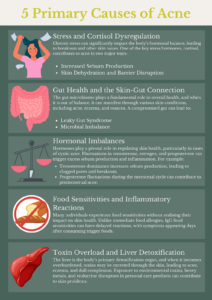
- Gut-skin and microbiome interactions
The result is:
- Fewer “trial-and-error” treatments
- Less reliance on oral contraceptives
- Calmer skin, better energy, and long-term hormonal stability
A More Complete Way to Care for Acne
Acne is not just a skin issue.
It is often a message from the body about stress, metabolism, and hormonal processing.
When we listen to that message — instead of silencing it — real healing becomes possible.
If you’ve been told “everything is normal” but don’t feel normal at all — you’re not imagining it.
You may simply need a deeper, more personalized map…